How to Cost a Pizza: Dough, Sauce, Cheese and Toppings by Size
To cost a pizza, add up what each ingredient on it costs you: the dough ball, the sauce, the cheese and every topping, each worked out from what you paid by the case and how much one pizza uses. Do it separately for every size, because a large uses more of everything, not just more cheese.
Most pizzerias know their prices to the cent and their costs to the nearest guess. The guess is usually fine until cheese moves, a new cook gets generous, or a specialty pizza turns out to cost more than it sells for. Here is a method that takes an afternoon once and minutes to update.
Step 1: Cost the dough ball as its own recipe
The dough is a recipe inside a recipe. Cost a whole batch (flour, water, yeast, salt, oil, sugar if you use it) from your latest invoices, then divide by the number of dough balls the batch makes at each size's weight.
Say a batch costs $16.80 and makes twenty large dough balls. Each large ball costs $0.84. If the same batch makes more, smaller balls for mediums and smalls, each of those costs less. Weigh the balls you actually make rather than the ones the recipe card says you make; the difference is often where the first leak is.
Step 2: Turn case prices into unit costs
Every other ingredient arrives in a case, a bag or a tub. Divide the price by the number of units in it, using the unit you portion in:
- A 20 lb case of mozzarella at $48.00 is 320 oz, or $0.150 an ounce.
- Sauce that works out to $12.00 for 128 oz is about $0.094 an ounce.
- Pepperoni at $36.00 for 200 oz is $0.180 an ounce.
These are made-up numbers for the example. Use your own invoices, and update them when the price changes; a cost based on last year's cheese price is a cost you made up.
Step 3: Weigh the portion for each size
Write down how much of each ingredient goes on each size, and check it with a scale, not a ladle and a feeling. For the example:
| Size | Dough ball | Sauce | Cheese | Pepperoni | Plate cost |
|---|---|---|---|---|---|
| Small | $0.55 | 3 oz ($0.28) | 6 oz ($0.90) | 1.5 oz ($0.27) | $2.00 |
| Medium | $0.70 | 4 oz ($0.38) | 8 oz ($1.20) | 2 oz ($0.36) | $2.64 |
| Large | $0.84 | 5 oz ($0.47) | 10 oz ($1.50) | 3 oz ($0.54) | $3.35 |
For takeout and delivery, add the box. It is a real cost of that pizza even though nobody eats it.
Step 4: Cost toppings per size, and halves at half
A topping isn't one price. Three ounces of pepperoni on a large costs more than one and a half on a small, so cost each topping at each size, the same way you price it. A topping on half a pizza uses half the portion, so it costs half. A specialty pizza is simply the crust plus its list of toppings at that size; cost it from the same numbers and you'll see straight away whether its price covers what goes on it.
Step 5: Food cost percentage, and the price that hits your target
Food cost percentage is plate cost divided by menu price. At $10.99, $13.99 and $16.99 the example pizzas run at about 18.2%, 18.9% and 19.7%.
To work backwards from a target, divide the plate cost by the target as a decimal. If you want the large at 22%, $3.35 / 0.22 is about $15.23, so $16.99 leaves room. A topping priced at $1.25 on a large that costs you $0.54 is doing well; one that costs $1.10 isn't.
The two-ounce mistake
Here is why weighing matters. If the large gets twelve ounces of cheese instead of ten, the plate cost goes from $3.35 to $3.65, and food cost on that pizza from 19.7% to about 21.5%. Nobody notices two ounces on one pizza. Across every large you sell for a year, it is one of the biggest numbers in the building. Portion scales and a laminated portion chart by the make line pay for themselves.
Keep it current without redoing it
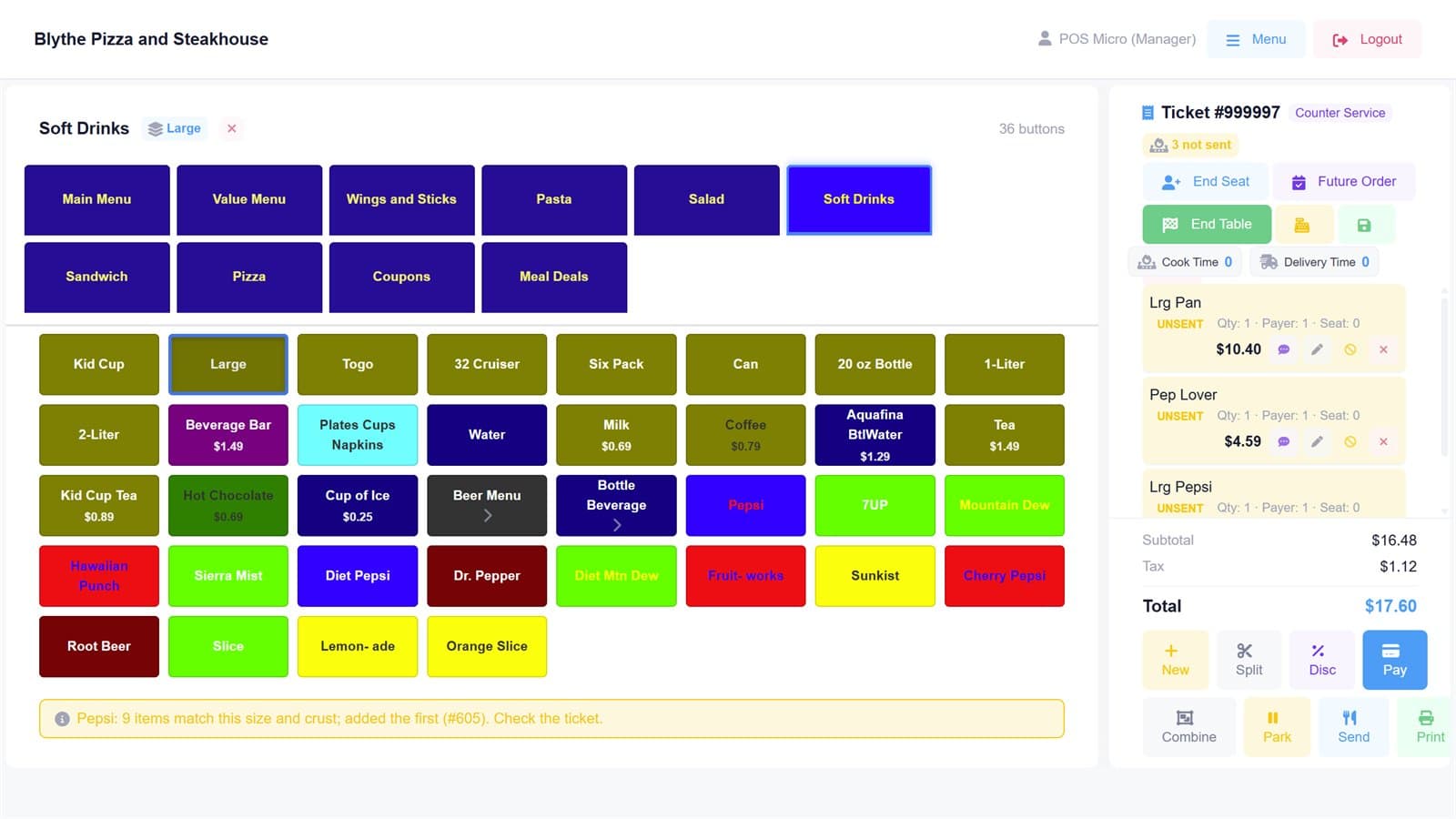
A costing done once drifts as prices move. The fix is to keep recipes in a system that reads your invoices. In CashSheet Back Office the dough ball is a sub-recipe, each size's recipe lists its portions, and costs update from what you last paid, so a cheese price change reaches every pizza that uses it. The pizza builder on the till prices crusts and toppings per size from the same matrix you just worked out.
Want to try one pizza first? The free food cost calculator starts with this example; replace the numbers with yours.