How USDA Measures Your Ribeye: Pick's Theorem on the Plant Floor
Why ribeye area matters
The ribeye muscle — the longissimus dorsi, exposed at the 12th-13th rib interface when the carcass is ribbed for grading — is one of the four inputs to the USDA yield grade equation. The others are external fat thickness, kidney-pelvic-heart fat percentage, and hot carcass weight. The bigger the ribeye, the better the yield grade, and the more closely-trimmed retail cuts you'll pull from the carcass.
How much does it move? A change of one square inch in ribeye area shifts the yield grade by 30 percent of a grade. Three square inches and you've moved a full yield grade. That's the difference between a Yield Grade 2 carcass (highly desirable) and a Yield Grade 3 (the middle of the market).
Pick's Theorem in 30 seconds
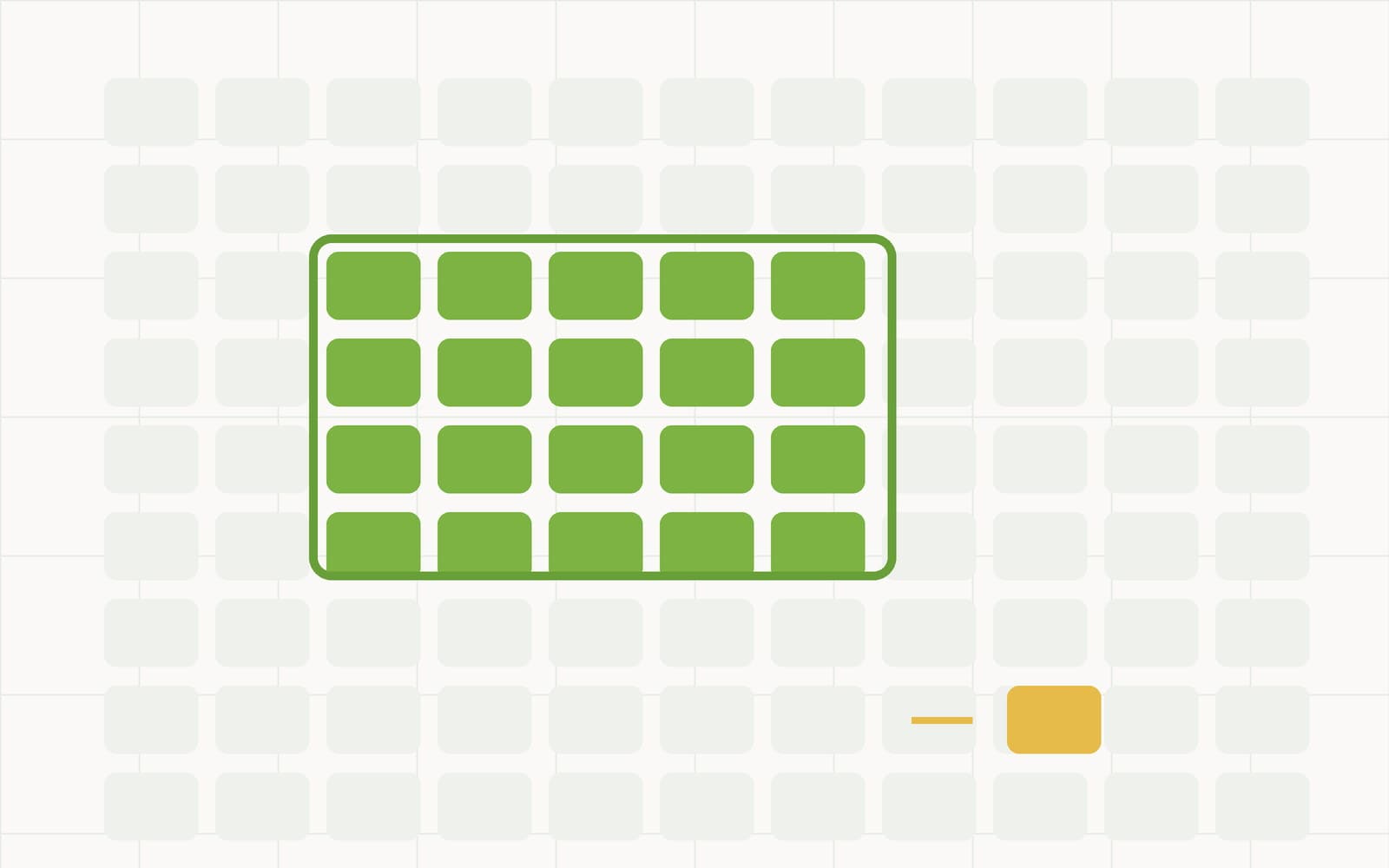
How do you measure the area of an irregular shape on a flat surface? In 1899, the Czech mathematician Georg Pick published a clean answer for shapes whose vertices land on a regular grid of dots:
Area = (interior dots) + (boundary dots ÷ 2) − 1
Drop a transparent grid over the shape, count the dots inside the perimeter, count the dots on the perimeter, plug into the formula. USDA's beef ribeye grid is sized so each cell is 0.1 square inches — so you multiply the Pick's result by 0.1 to get the final area.
The official method
USDA's Method for Grid Assessment of Beef Carcass Ribeye Area (May 2011) lays out the procedure:
- Place the grid randomly on the cut surface of the ribeye. Don't align it to the muscle's long axis — that introduces sampling bias.
- Count interior dots (completely surrounded by lean).
- Count boundary dots (touching the perimeter), divide by 2.
- Add the two counts. Subtract 1.
- Multiply by 0.1.
The USDA worked example: 98 interior + 9 boundary → 0.1 × (98 + 4.5 − 1) = 10.15 square inches.
The rapid method
If you don't need official-grade precision, there's a faster variant. Align the grid to the long axis of the ribeye, skip the "−1" at the end. It slightly overestimates (USDA is explicit about this) and introduces sampling bias from the alignment, but for a quick floor check it's usable. The same example, rapid method: 100 interior + 9 boundary → 0.1 × (100 + 4.5) = 10.45 square inches.
USDA's warning: don't use the rapid method when you're within 1 square inch of a critical yield-grade threshold. That's a 0.32 yield-grade margin — enough to flip the grade.
How instruments have changed this
USDA approved instrument-aided ribeye measurement in 2001, instrument yield grading in 2007, and instrument marbling in 2009. Most large plants now have camera-based grading that returns ribeye area in milliseconds. But the plastic grid is still the reference — when there's a dispute about an instrument reading, the grid is what arbitrates.
From the cutting board to your LP
CutSheet's yield matrix carries a ribeye-area expectation for each carcass type and program. When actual measurements diverge from expected — instrument reports a 9.8 sq in average for what the matrix says should be 10.5 — that's a signal. Either the matrix is stale or the cattle coming in are different from what it was built on. The standards aren't just a regulatory artifact; they're how a plant knows whether its plan still matches reality.