Should You Grind It? Pricing the Cut-or-Grind Decision When Premium Cuts Stall
The carcass doesn't care what's selling
When households tighten up, they trade down the carcass. The middle meats go first — ribeyes, strips, tenderloins sit while the grind case empties. Foodservice orders for premium steaks soften; retail features shift to chubs.
The animal, meanwhile, is indifferent. Every carcass still yields the same primals in the same proportions it always did. You have already paid for the whole thing. So you end up holding the expensive part of a carcass that the market has temporarily stopped wanting, while the part that is moving is the cheapest thing you can make.
Which leads a lot of plants to the same conclusion: grind it.
Sometimes that's exactly right. But "grind it" made on instinct is one of the most expensive habits a plant can develop, because grinding is irreversible. You can always turn a ribeye into trim. You can never turn trim back into a ribeye.
Grinding isn't a fallback. It's a priced decision.
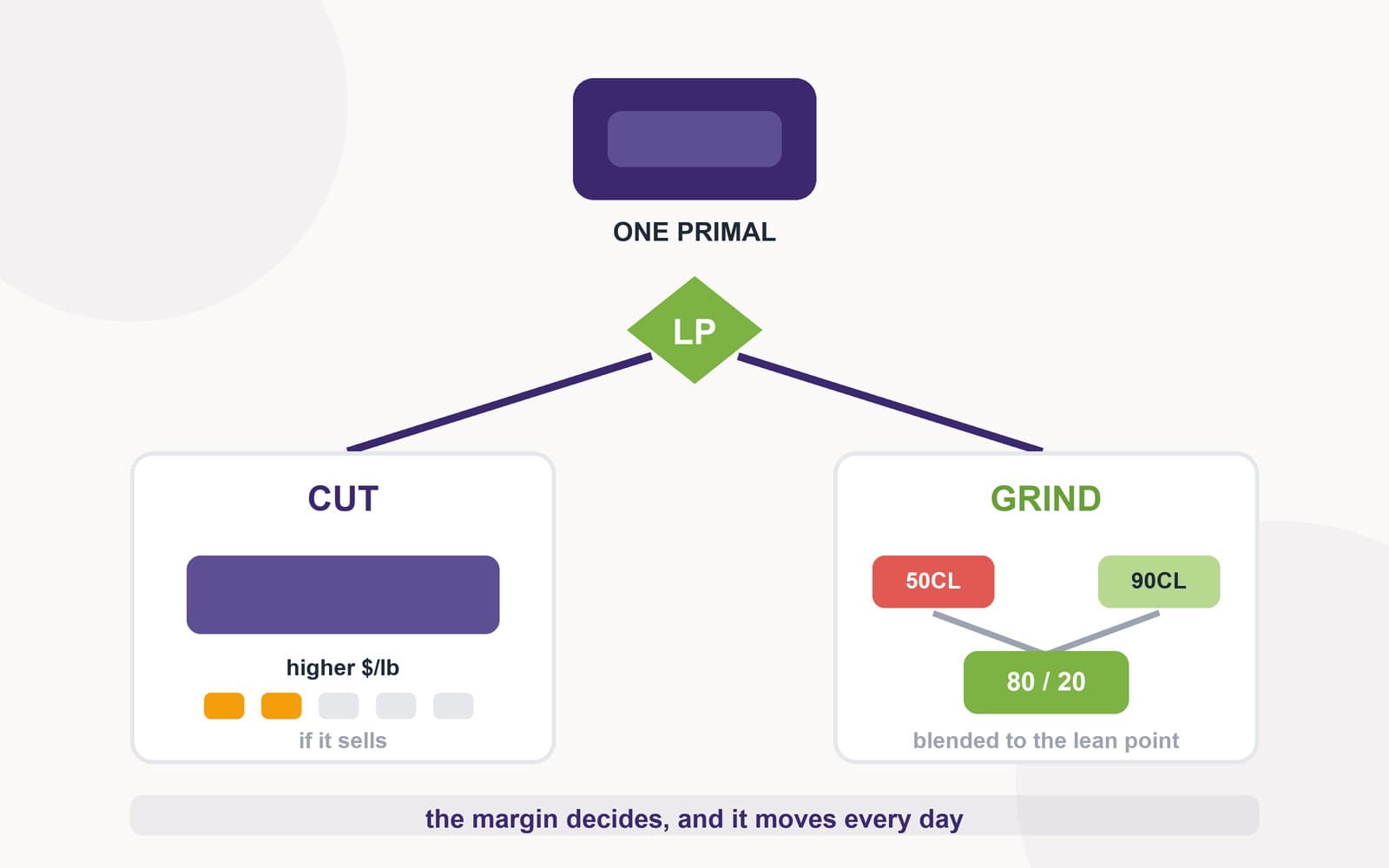
The real question is never "should we grind?" It's an opportunity-cost question with a number attached:
At what price does diverting this primal to grind beat holding it, discounting it, or fabricating it differently?
Answering that requires four things to be true at once, and they're all moving:
- What is each disposition worth today? Not last week's price sheet — today's cut value against today's trim quote.
- What will the blend actually need? Trim only has value in the context of the blend it's going into and the lean point that blend has to hit.
- Can the floor execute it? A plan that ignores labor hours, shift structure, packaging lines and cooler space is a wish, not a plan.
- What have you already promised? Product committed to a customer on Friday is not available to grind on Wednesday.
Any one of those is a spreadsheet exercise. All four together, re-solved every day, is a linear program.
A worked example (illustrative)
Numbers here are hypothetical — plug in your own — but the shape of the arithmetic is the point.
Say a primal can be fabricated into a premium cut worth substantially more per pound than trim. Obvious call, except: it's been sitting four days, the buyer who normally takes it has gone quiet, and it has a shelf-life clock. Holding it costs cooler space and working capital, and there's a real probability it gets marked down anyway or moves at distressed pricing later in the week.
Meanwhile the trim market is firm, and your 50CL supply is short relative to what the blend schedule needs — meaning that primal's trim is worth more than the generic trim quote, because it relieves a binding constraint in the blend.
That last part is what human judgment consistently misses. The value of grinding isn't the trim price. It's the trim price plus whatever it saves you elsewhere in the blend. Sometimes that flips the decision; sometimes it doesn't. You cannot tell by looking.
Ground beef is a blending problem, not a grinding problem
Ground beef isn't "meat that got ground." It's a formulation that has to land on a lean point — 73/27, 80/20, 85/15 — at the lowest cost from whatever raw material you actually have.
That means blending lean and fat streams: 90CL against 50CL, plus whatever else is available, to hit the target within tolerance. When the spread between those streams moves — and it moves constantly — the least-cost blend changes with it. A recipe that was optimal in March can be quietly destroying margin in July while producing a perfectly in-spec product.
CutSheet models this directly: grind groups carry a lean point and a maximum lean point, blends carry recipes and results, and raw material is mapped to grind with the LP choosing the mix. When the spread moves, the blend re-solves. Nobody has to notice the spread moved.
Two clocks, not one
Here's a subtlety most planning tools miss entirely: boxed beef and grind trim don't run on the same clock.
A boxed primal you can hold for several days is a genuinely different decision from trim that has to be blended and packed in a much shorter window. Planning them on a single horizon forces a compromise that's wrong for both.
So CutSheet plans them on separate horizons — one planning window for the boxed-beef side, a shorter one for the ground-beef trim side. The cut decision gets the runway it deserves; the trim decision gets the urgency it actually has.
Prices move daily. Your plan should too.
The objective coefficients that drive these decisions — what each product is worth to you — live in a live incentive table, and prices can be refreshed into a running engine without restarting it. Price changes route through an approval step first, so nobody moves the plant's economics by accident.
The practical effect: you can re-plan against this morning's market before the first shift, not after the quarter closes.
The plan has to be executable
An optimizer that returns a beautiful answer your plant can't run is worse than useless — it burns trust the first time the floor can't hit it.
So the model carries the constraints that actually bind: labor limits and shift schedules, sale limits, packaging capacity, freezer rack space, production limits by plant and program. Roughly forty constraint families in total. The optimum it returns is the best plan you can actually execute tomorrow, which is the only kind worth having.
And don't oversell what you just decided to grind
The flip side of aggressive grinding: you can quietly grind away inventory you'd already promised. That's an expensive surprise in a tight market — you pay once in customer damage and again in the panic buy to cover it.
Before an order is accepted, the same LP answers whether the plan can actually produce it in the requested window. Available-to-Promise isn't a separate system bolted on — it's the same model that built the fab plan, answering a different question.
What this won't do for you
Worth being straight about the boundary:
- It is not a price forecaster. It optimizes against the prices you give it. Where the cutout goes next month is still your call.
- It does not replace a trader's judgment on when to be long or short inventory. It tells you the best disposition of what you're actually holding.
- It is only as good as your yields and prices. Stale data produces a confidently wrong plan — which is more dangerous than an obviously wrong one.
The bottom line
In a soft market for premium cuts, the plants that hold margin aren't the ones that grind the most or the least. They're the ones that know, per primal and per day, which decision was worth more — and can prove it afterward against the books.
Grinding a ribeye should never be a shrug. It should be an answer.